
What You Need to Know Today:
- After a volatile weekend with Israel and Iran launching attacks at each other, peace seems to have returned to the region after President Trump called for both sides to cease hostilities.
- Soybean trade remains defensive as funds are liquidating longs amid no signs of Chinese buying and favorable U.S. weather conditions.
- Corn and wheat managed to turn higher on technical support and, for corn specifically, stronger export demand.
- The USDA reported a second case of NWS in Texas, which triggered risk-off selling in cattle futures and pushed the entire livestock sector lower.
- Funds are driving the market right now, which is increasing agricultural markets’ technical nature and making futures more responsive to chart conditions.
The Big Picture: Grain and oilseed futures tried to rally Sunday night, but the latter sector quickly reversed course on lack of conviction and fund selling. Even corn struggled a bit through the day session before finally seeing an export-driven surge around midday. Funds are thought to have shed all but the last dregs of their formerly massive long position in corn, amid weak technicals and favorable weather in the U.S. and South America, leaving long-term strength in corn unlikely. That is weighing on broader grain markets, with few willing to maintain ownership while funds are selling. Corn and wheat did manage to make some positive headway on the charts, with wheat being particularly responsive to today’s discovery of support at key technical points. That suggests markets could swing higher in the near-term, though as noted earlier, the long-run outlook remains mostly bearish.
Export Updates
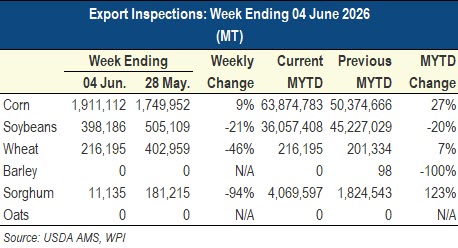
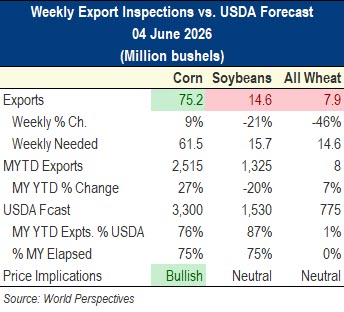
The weekly Export Inspections report was mixed for the major grains, with corn inspections rising from the prior week and topping pre-report expectations of 1.65 MMT. The volume was also once again well above USDA’s target pace, which hints that the 3.3-Bbu forecast may still be too small.
Conversely, the report was disappointing for soybeans, as shipments fell from the prior week and narrowly missed both USDA’s target pace and pre-report expectations (450 KMT).
Wheat also received a bearish blow from the report as exports fell sharply from the prior week to start the new marketing year and were below pre-report expectations (350 KMT) and USDA’s target pace.
Outside Markets
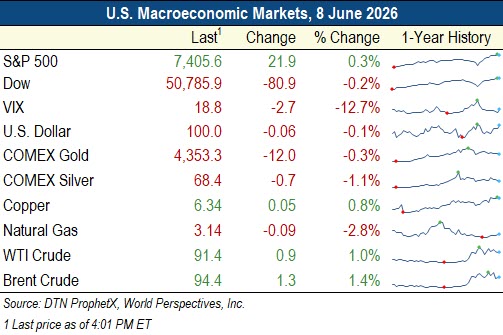
Outside markets were mixed to start the week, with investors unnerved by the recent escalation of tensions between Israel and Iran. The good news is that the attacks seem to have moderated following requests by President Trump, but the situation underscores the fragility of Middle East relations. The stock market wobbled on either side of unchanged, with tech shares recovering a bit from their recent selloff. Crude oil futures were understandably higher following the weekend attacks in the Persian Gulf.
Notable Market News
Late Friday, USDA confirmed a second case of New World screwworm in Texas, just five miles away from the first.
USDA reported the following private export sales:
- 264 KMT of soybeans sold to unknown destinations for 2026/27
- 103 KMT of corn for delivery to Japan, of which 40 KMT is for delivery in 2025/26 and the balance (63 KMT) is for delivery in 2026/27.
Market chatter says South Korean flour millers purchased 19.5 KMT of U.S. milling wheat and 10.5 KMT of Canadian milling wheat. The U.S. purchases were thought to include 10.7 KMT of DNS at $289.35/MT and 7.8 KMT of white wheat at $244.43/MT and 1,000 MT of HRS wheat at $284.66/MT (all prices FOB).
IKAR pegged Russia’s June wheat exports at 2.5 MMT, down from May’s 3.4 MMT program.
APK Inform raised Ukraine’s 2026 wheat harvest from 19.9 to 21.7 MMT.
AgRural says Brazil’s safrinha corn harvest is 4.4 percent complete, up 2 points from the prior week.
Russia’s Novorossiysk Black Sea port has caught fire after a drone attack, per local media.
Corn
Futures
Key Takeaways: Old crop corn futures staged a bullish reversal on Monday on the heels of strong exports, but the lack of a bullish story has WPI’s outlook neutral/bearish with an anticipated $4.15-4.30 trading range.
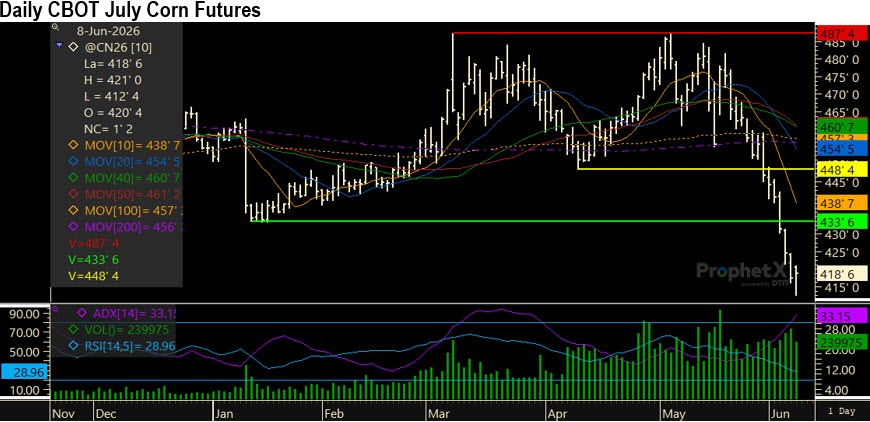
Commentary: Corn futures managed to post a bit of a technical rebound on Monday with back-and-forth trade eventually yielding to bull spreading that produced a higher close. Strong export data – including the weekly Export Inspections data and a “flash” sale to Japan – provided much of the fundamental support to justify commercial bull spreading.
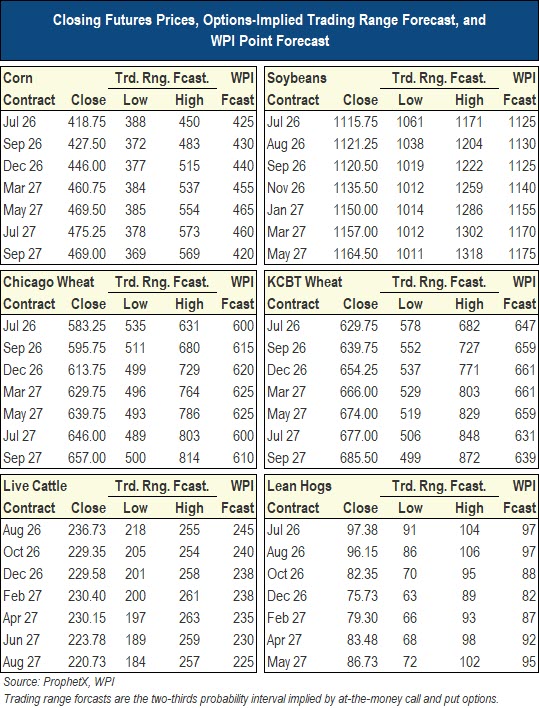
July futures sold off below the $4.15 point late in the overnight session and immediately after the morning open, and found support near $4.12 each time. That offered bulls enough support to push the market higher into the $4.20 range and form a bullish reversal on the charts. Notably, the reversal came with the RSI at oversold levels of 28.9, which made the contract ripe for a turnaround. The contract is now looking to stabilize and possibly grind higher, though funds’ massive short position will make that difficult. Funds are thought to be either barely long or net short about 30,000 contracts, which will help keep price action defensive in the absence of poor weather or a sudden demand surge. WPI remains neutral/bearish corn going forward with an expected trading range of $4.15-4.30.
Soy Complex
Futures
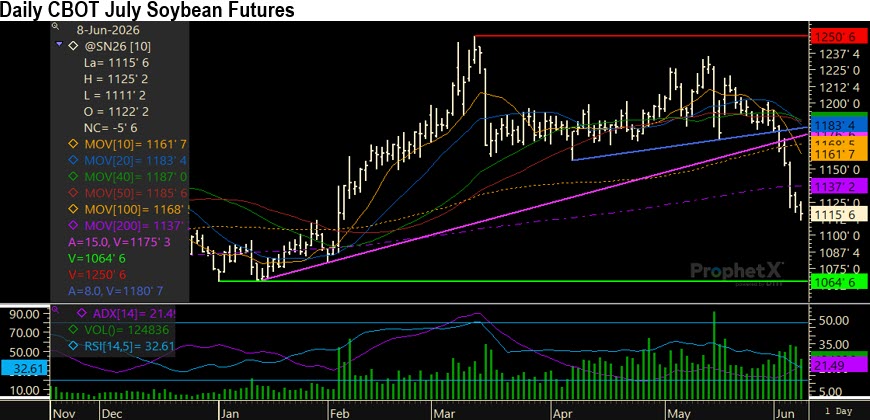
Soybean Key Takeaways: Bears drove soybean futures to new selloff lows to start the week amid a lack of Chinese buying and weaker export data. Limited technical support exists immediately below today’s settlement values, implying downside risk remains.
Commentary: Soybean futures pushed lower and closed in the red for the seventh straight session amid uncertainty on the Chinese demand outlook, weak export data, and favorable weather in the U.S. Bear spreading tipped commercials’ hand on their perception of old crop demand, and the July-August spread fell ¾ cents to -5 ¼ while the July-November spread fell 3 ½ cents to -19 ½, the lowest value to date.
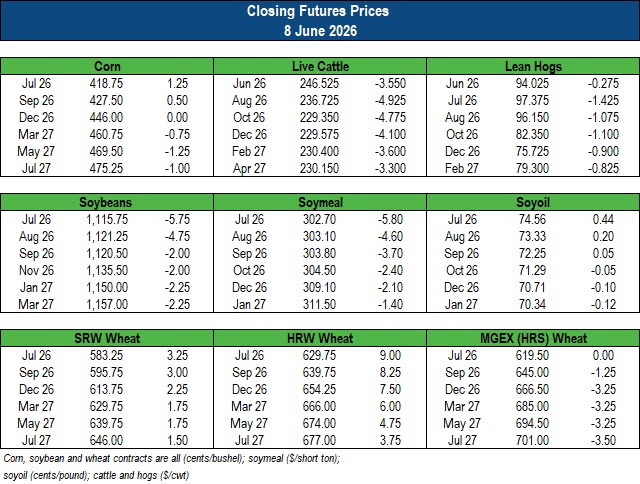
Futures themselves fared little better than spreads did Monday, with July futures falling 5 ¾ cents and plunging to a new selloff low. The contract ended about 4 cents above the day’s lows ($11.11) in moderate-volume trade. November futures settled 2 cents in the red and scored their third straight close below the 100-day MA and the $11.50 mark. Neither contract is particularly near major support levels nor is technically oversold, so near-term support seems minimal. Funds have been rapidly exiting soybean longs over the past month and there is nothing on the charts indicating that trend will stop any time soon.
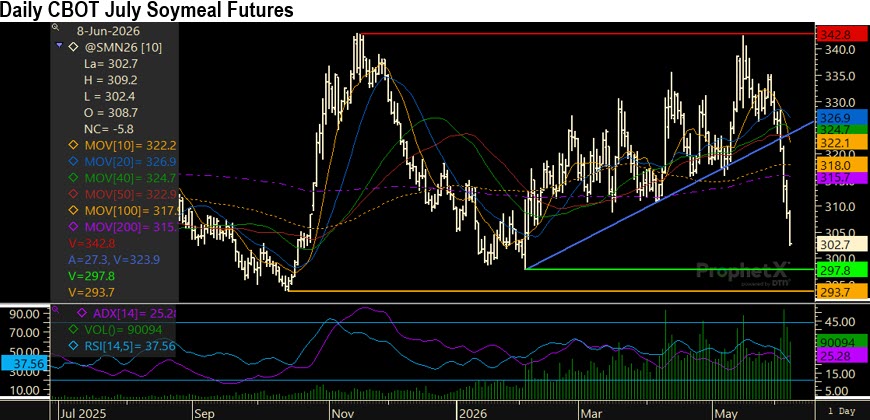
Soymeal Key Takeaways: Soymeal futures are plunging lower amid strong technical selling but are approaching levels where export demand and/or technical support could soon staunch the bleeding.
Commentary: Soymeal futures dropped sharply lower for the fourth straight session with funds rapidly exiting any lingering longs, which are now likely deeply underwater. Since snapping trendline support last Wednesday, soymeal futures have collapsed $30 and are now targeting the early-February and mid-October lows for support. Futures down near $300/ST could trigger some more physical and export buying, but so far the export wires have been a bit quiet. Futures are approaching oversold levels and could be ripe for a rebound off support near $300 or slightly lower.
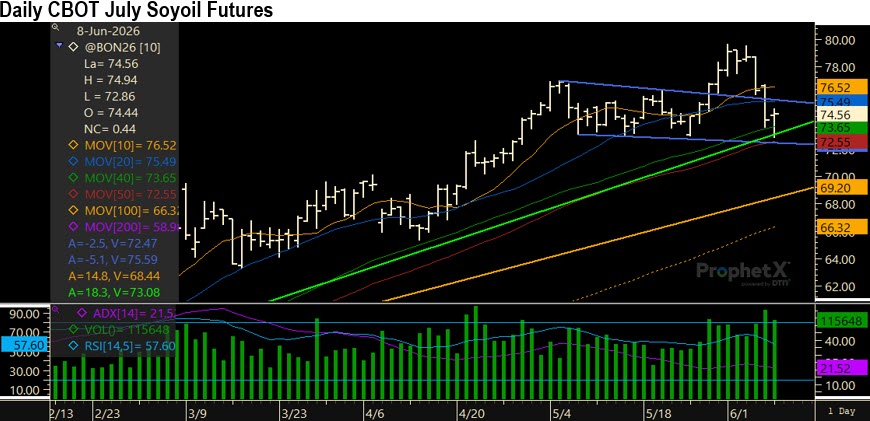
Soyoil Key Takeaways: Soyoil futures bounced off trendline support to open the week, suggesting bullish trends and sentiment remain intact, which clears the way for another run at the contract highs.
Commentary: Of course, soyoil was the only leg of the soy crush to find support Monday with the U.S.’s bullish biofuel policy hovering in the background and supporting any meaningful market break. Higher crude oil futures may have also helped soyoil post a higher day, but the vegoil market has become increasingly decoupled from crude oil over the past 3 weeks or so. Instead, WPI sees Monday’s action in soyoil as technically dominated with underpinnings of the long-term fundamental outlook.
July soyoil settled 0.44 cents/lb higher after it initially broke lower to test support at the nearest trendline and the 50-day MA. The contract found its daily low between those two points and the implicit support allowed the market to rally and close above the trendline, thereby confirming its ongoing influence. After a strong, two-day selloff, the market rebounded off major technical support and just below a key psychological value (73.00). That all points to a high likelihood of a continued bull move and a re-test of the contract highs.
Wheat
Futures
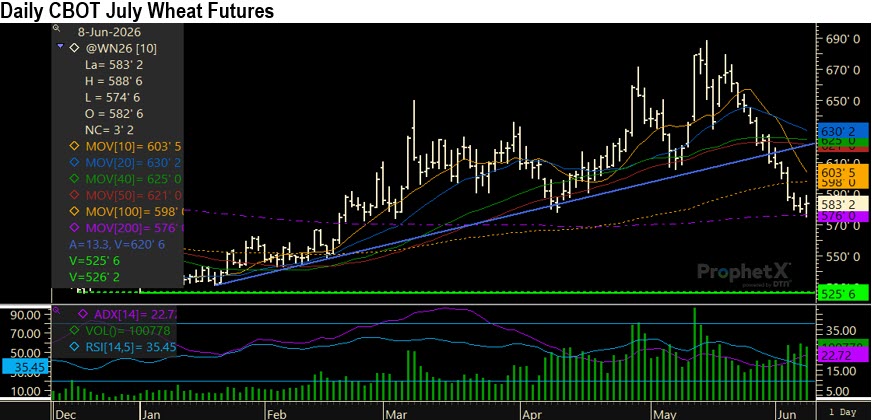
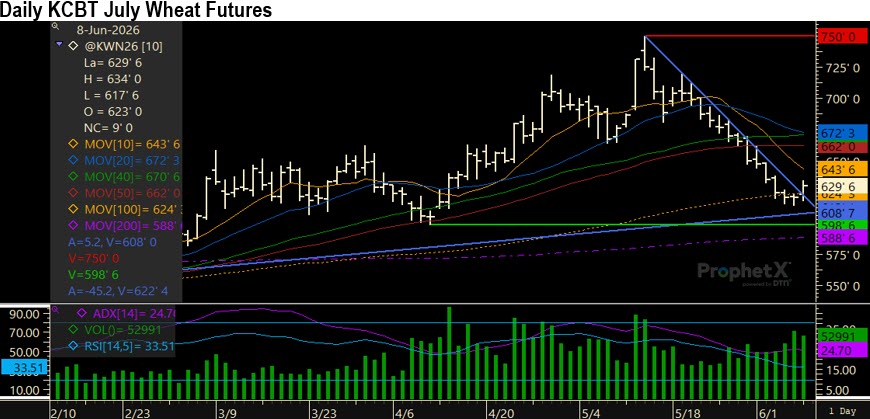
Key Takeaways: Wheat futures uncovered solid technical support Monday and turned higher, with WPI’s technical analysis pointing to a strong likelihood of a pending wing higher.
Commentary: Wheat futures finally found a bit of support after their recent two-week drubbing. Market chatter suggests the ongoing harvest, while pressuring physical values, may now be priced into futures, which offered some relief. Too, there are concerns about lower Southern Hemisphere production for 2026 due to El Nino, which could be more consequential after this year’s sharply-reduced U.S. harvest. Those harvest concerns received a bit of a boost recently with sporadic and scattered rains across parts of Kansas and Oklahoma slowing harvest.
While these factors may have been in the background, WPI sees the day’s trade as far more technical in nature. July CBOT wheat found its lows a tick below the major psychological level of $5.75, which was just a penny below the 200-day MA. Hard to argue that technical buying didn’t play a role in today’s trade. The contract settled 3 ¼ cents higher for the day with some very light bull spreading entering the complex as commercials turn a bit more optimistic about export demand following the recent $1.10 slide in futures.
Similarly, July KCBT wheat settled 9 cents higher with light bull spreading helping pull the contract off Friday’s lows and above the 100-day MA and the resistance trendline. The contract came within 5 cents of the long-term supporting trendline on Friday, and combined with concerns about this year’s HRW production that was enough to embolden bulls on Monday. The contract’s close above the resistance trendline suggests a pending swing higher, likely into the $6.50 or $6.62 (the 50-day MA) ranges.
Cattle
Futures
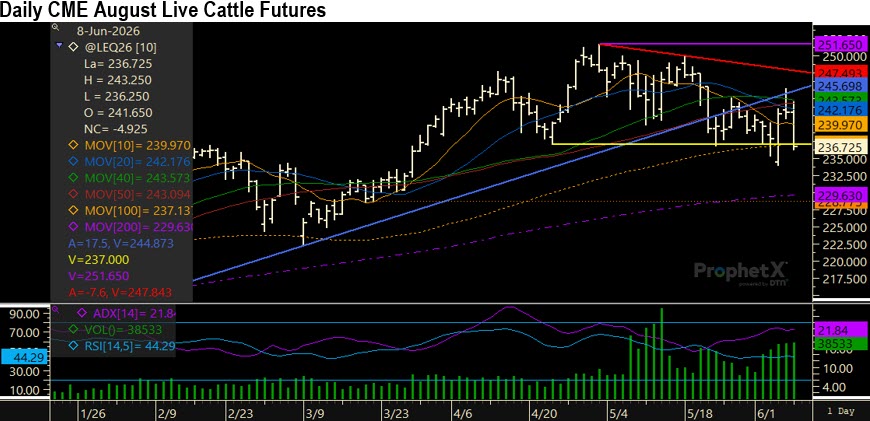
Key Takeaways: NWS is causing short-term panic selling and risk-off trading that sent live cattle futures below major support levels Monday. An extended pullback, however, should be a buying opportunity given the broader fundamental support.
Commentary: Cattle futures were down hard all day to open the week with traders adopting a “risk off” mentality as two NWS cases have now been confirmed in Texas. The long-run outlook is that NWS will likely limit transportation of animals and, therefore, be supportive for prices, but for now it’s a “sell the rumor” environment.
August live cattle futures settled $4.925/cwt lower on Monday and ended below both trading range support ($237.00) and the 100-day MA, ending below the latter point for the first time since 29 December. The move is a technical bomb that destroys key chart support upon which bulls depended, coming with above-average and still-rising trading volume, which adds greater weight to the technical move. Now, the contract is targeting support at the 200-day MA and the mid-March pullback lows near $228-229. WPI’s fundamental analysis suggests futures have little risk of moving below that point and so a pullback to these levels is likely a solid buying opportunity.
Friday’s cash cattle trade rewarded the patient with prices in the South printing near $258/cwt, up $1-2 from trade earlier in the week. The weekly average was still in line with the prior week’s, so it’s hard to say cattle feeders really got the upper hand. Another week of sideways trade does, however, point to cattle and beef markets being a bit more balanced right now.
Cattle slaughter last week pushed a little higher to the 533,000 head mark, down about 50,000 head from this time last year but up slightly from recent lows. The dramatic reduction in slaughter is the reason beef prices have maintained their strength, though that has waned a bit over the past month or so.
Beef prices were mixed on the morning boxed beef report with the Choice cutout down $0.67/cwt and the Select cutout up $0.99/cwt. Prices are hovering just below the $400 threshold for the Choice cutout and $390 for Select boxes, which is disappointing for bulls who were expecting Choice values to trade into the $410-420 range by this time.
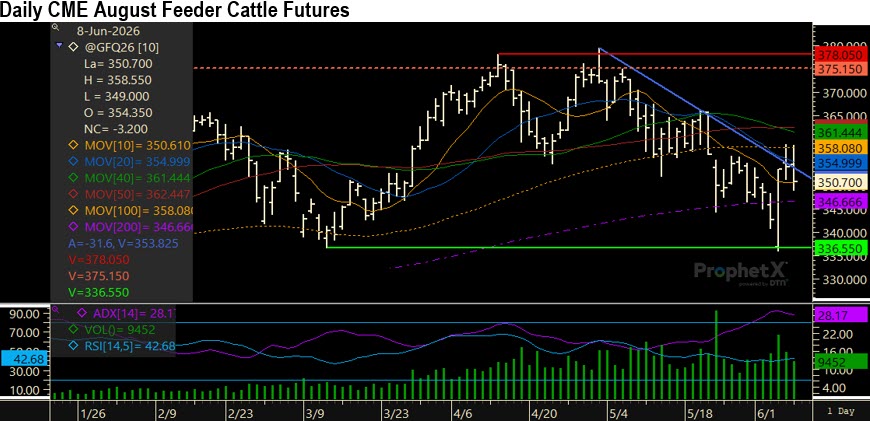
Feeder Cattle Key Takeaways: Feeder cattle are facing increasingly bearish near-term technical conditions amid NWS-related selling, but strong physical trade and major technical support at $336.55 indicate a more neutral/bullish long-term outlook.
Commentary: Feeder cattle futures followed the live cattle market lower after an early move higher uncovered technical resistance and fund selling. Some of the selling was motivated by fears over NWS, but most was technical in nature. Friday’s trade that took August futures briefly above trendline resistance and the 100-day MA failed to garner enough support to force a close above either point, thereby triggering a bearish look to the charts. That, combined with the headline-driven selling in live cattle futures, left bears in full control Monday.
August feeder cattle settled $3.20/cwt lower in moderate-volume trade with resistance at the 100-day MA rejecting an early rally. The subsequent selling pressure sent futures briefly below the 10-day MA and $350 mark, but bulls were able to force a close above both points. That leaves the market with near-term support amid a rapidly weakening medium-term technical environment, which leaves WPI with a bearish bias for the next week or two. The market needs to find support at the 200-day MA for any hope of a near-term rebound while the $336.55 level (the mid-March lows) will likely again prove a solid floor for long-term trading action.
Part way through the weekly Oklahoma City feeder cattle auction, cattle are trading sharply higher despite the futures weakness. Steers are $4-8/cwt higher while heifers are trading $8-12/cwt higher.
Lean Hogs
Futures
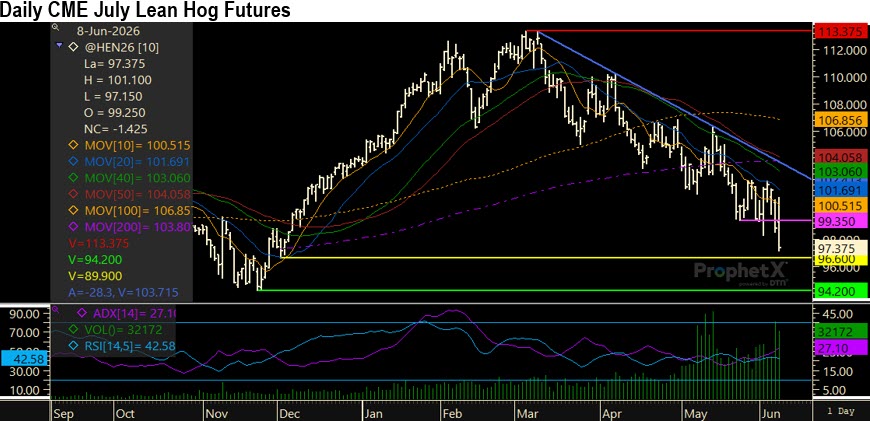
Key Takeaways: The bearish trend continues in hog futures with funds eagerly selling. Meaningful technical support is still a bit away, however, and momentum indicators indicate more downside potential ahead.
Commentary: Lean hog futures sold off again to start the week with relentless bearish technical pressure driving the move. As anyone who has read WPI’s articles in the past three months knows, lean hogs have been locked in bearish action that has only intensified in the past month. That has prompted funds to rapidly liquidate a formerly massive long position in hog futures, in turn accelerating the downside move. Funds are short the hog market – and likely by a seasonal record amount – as bearish sentiment builds.
July lean hog futures settled $1.425/cwt lower in heavy-volume trade to start the week, and followed through on Friday’s bearish settlement below former support at $99.35. The market briefly tried to rally in early trade, but quickly uncovered resistance above the 10-day MA and $100 mark with funds adding to selling pressure as the rest of the livestock sector sold off.
July futures settled less than $1.00 above minor support at $96.60 and are within about $3 of major support at $94.20, which makes the next several day’s technical action very influential. Futures are not yet technically oversold (RSI at 42.58), which suggests additional downside potential. Further, the strong ADX (27.1) indicates funds and technical traders will likely use rallies as selling opportunities. WPI suspects the selling in hog futures is not done yet, and we’ll likely test the major support levels near $94-95 before any serious rebound effort can begin.
Cash hog prices were firmer on the morning National Daily Direct report with 1,068 head sold for $96.01, up $1.83 from the prior day and up about $1 from the five-day rolling average.
The pork cutout fell $0.42/cwt to open the week with the morning pork report showing $3-4/cwt losses in loins, butts, and picnics, that offset a $6 rise in belly values.
Closing Futures Prices
 What You Need to Know Today: New World screwworm is back in the headlines after new cases were found in a hunter-harvested elk in Texas and a beef cow in New Mexico. The detection in wildlife could further complicate containment efforts, as implementing effective biosecurity measures is consid...

 Cattle on Feed Expectations USDA’s monthly Cattle on Feed report that will show cattle inventory statistics as of 1 October will be released tomorrow, 23 October. Analysts’ pre-report consensus estimates are for the total inventory on feed to be 100.3 percent of last year, which imp...

 Key Takeaways: Dry bulk markets remain mixed with Capesize rates turning around from their recent weakness and posting solid gains on improved Chinese demand. Panamax vessels, on the other hand, saw rates decline amid greater tonnage availability in the South Atlantic and falling U.S. Gu...