With considerable fanfare—and few specifics—USDA last week announced its Great American Cotton Plan for 2026-2031. Secretary Brooke Rollins and industry leaders described the initiative as a comprehensive strategy to address the persistent challenges facing U.S. cotton production, domestic textile manufacturing, and export competitiveness.
The scope of the proposal is ambitious. Unlike earlier cotton programs that focused largely on supporting farm income, the new plan attempts to strengthen the entire supply chain through a mix of producer assistance, textile mill incentives, consumer promotion, and export development. Whether the announced measures can meaningfully alter the long-run economics of the cotton industry is a question that will require considerably more detail to answer.
The Four Pillars of Support
Let’s look at the details of the plan. USDA describes the plan as having four pillars:
- Promoting domestic cotton use through its “plants not plastic” marketing effort, expanded use of it BioPreferred program, and increased marketing loan rates.
- Expanding domestic textile production through preferred access to rural development marketing loans and an increase in the Economic Adjustment Assistance for Textile Mills.
- Securing cotton import commitments from trading partners, specifically Bangladesh and Indonesia.
- Expanding access to subsidized risk management instruments such as Agriculture Risk Coverage (ARC) and Price Loss Coverage (PLC) programs
There is a great deal to process in the proposal. Regarding the promotion of domestic cotton use, there is some historical precedent to consider. Cotton Incorporated's famous "Fabric of Our Lives" campaign was launched in 1989 using producer check-off funds and remains one of the most recognizable commodity promotion efforts in American agriculture. Today, Cotton Incorporated continues to invest in consumer marketing, product development, and sustainability messaging, with an annual budget approaching $90 million.
The new "Plants Not Plastic" initiative appears to pursue many of the same objectives. However, USDA has provided few details regarding funding levels, implementation, or the relationship between the federal initiative and Cotton Incorporated's existing programs. As a result, it remains unclear whether the campaign represents a substantial new investment in cotton promotion or simply a federal endorsement of efforts already underway within the industry.
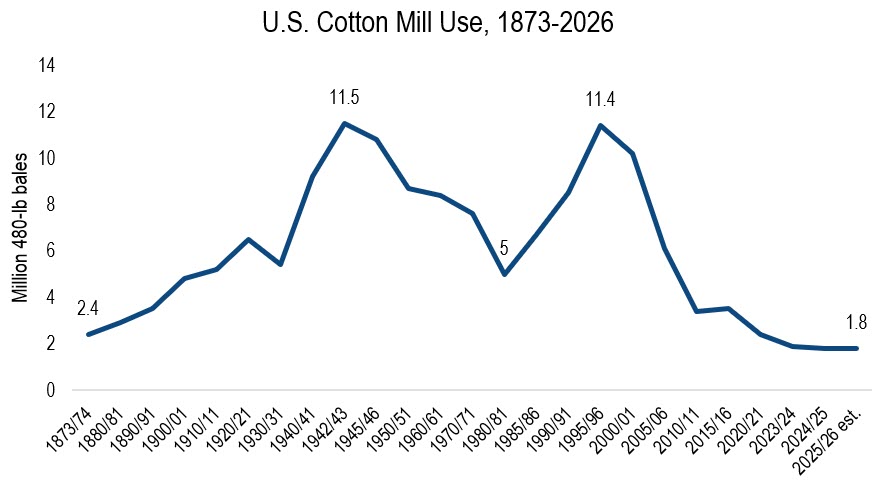
The historical record also suggests caution. Domestic mill use of cotton expanded during the 1990s and peaked at more than 11 million bales. Since then, however, consumption has fallen dramatically despite Cotton Incorporated's continued promotional programs. Today, domestic mill use is estimated at less than 2 million bales annually, the lowest level in well over a century. The principal challenge facing the cotton industry may therefore be less about consumer awareness and more about the long-run decline of the domestic textile manufacturing sector.
The same uncertainty surrounds the plan's emphasis on USDA's BioPreferred program. Established under the 2002 Farm Bill and expanded in subsequent legislation, BioPreferred was designed to encourage the use of products derived from renewable biological materials as alternatives to petroleum-based products.
But cotton-based products already qualify for certification under the program.
Consequently, the announcement raises an obvious question: what exactly will change? USDA has indicated that BioPreferred will play a larger role in supporting cotton demand, but it has not yet explained whether the program will receive additional funding, revised eligibility standards, new procurement preferences, or other incentives specifically targeted toward cotton products.
A more direct approach is found in the USDA plan’s second pillar, which describes additional support to textile milling. Specifically, the support comes in the form of rural development loans and raising the Economic Adjustment Assistance for Textile Mills program payment from 3 cents to 5 cents per pound of cotton processed. While neither initiative is entirely new, both could provide incremental support for domestic textile manufacturing. Their ultimate impact may be limited, however, as access to capital and margin protection are not the industry's primary challenges. Competition from lower-cost producers abroad remains the dominant factor shaping investment decisions in textile production.
The third pillar is something that we have grown to expect from the Trump administration. Direct commitments to import products from the U.S. is the foundation of its trade policy. Regarding Indonesia, their government has agreed to support commercial arrangements to import at least 163,000 MT (748,000 bales) of U.S. cotton annually for five years and then maintain a minimum of at least 150,000 MT (689,000 bales). For Bangladesh, their apparel and textile exports will enter the U.S. tariff-free, provided they are produced with U.S. cotton and can meet other rules of origin requirements.
Unlike traditional trade agreements, these commitments appear to be commercial targets rather than legally enforceable obligations. Their success will ultimately depend on market conditions and the willingness of textile manufacturers in Bangladesh and Indonesia to continue sourcing U.S. cotton. Both Bangladesh and Indonesia are however major suppliers of apparel to the United States and have strong incentives to meet their commitments to the U.S.
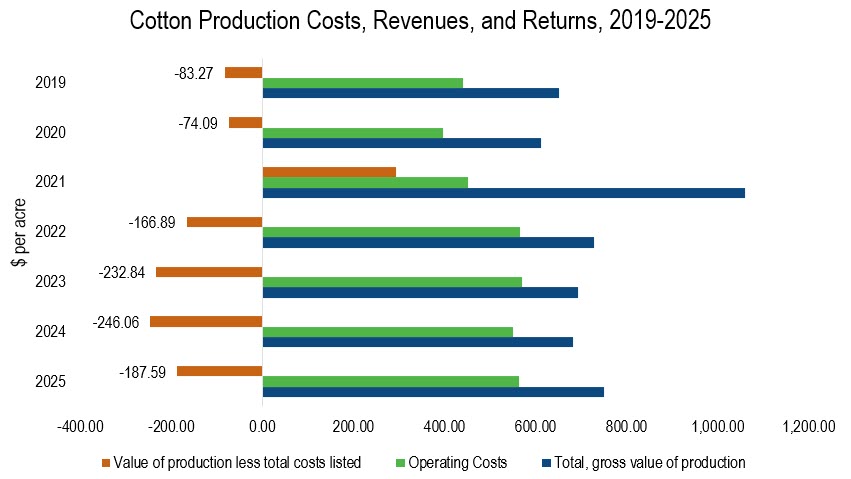
Pillar 4, which relates to domestic support for cotton production, is the most practical and worthwhile to the industry. Cotton has struggled to generate profits for farmers. In USDA’s Costs and Returns surveys, cotton has seen negative returns in 6 of the last 7 years, as seen below in the chart. Additional support in the form of the proposed 14 percent increase in the seed cotton reference price for the 2026 crop year will expand Agriculture Risk Coverage (ARC) and Price Loss Coverage (PLC) payments to cotton farmers.
This is again not a new program: cotton has been eligible for ARC and PLC payments since 2018. These payments form the backbone of USDA’s support to cotton farmers, and a 14 percent increase in the reference price for seed cotton will directly support farmer incomes. It is currently unclear whether USDA will further increase the reference price for seed cotton or use interventions to support farmer incomes.
Some Details Needed
The Great American Cotton Plan acknowledges many of the structural challenges facing the industry, including weak farm profitability, declining domestic mill use, and increasing foreign competition. Several of its components may provide meaningful support to producers in the near term, particularly the proposed increase in the seed cotton reference price. Yet the industry's largest challenges are rooted in long-term shifts in global textile production and consumer markets. Until additional implementation details are released, the plan appears less like a comprehensive restructuring of the cotton economy and more like a collection of existing programs, targeted incentives, and trade initiatives brought together under a single banner.


 Markets are caught between reasons to keep selling and reasons to take another look. Fund liquidation and renewed peace talks are pressuring grains, while fresh export business and some diesel relief offer encouragement. Corn recovered nearly 10 cents from its low to finish higher, while soybea...

 Key Takeaways: President Trump announced $8 billion in additional agricultural assistance through the Harvest Fuel Relief Program, as USDA projects farm fuel and oil expenses will increase 28.8 percent in 2026. The package follows $12 billion in earlier relief, while government farm payments w...
 Key Takeaways: A student group from the University of Chicago is protesting to bring back onion futures trading. Trading in onion futures was banned in 1958 following a spectacular bout of market manipulation that resulted in a corner of the physical market. The ban on onion futures led t...